
Top Stories
For the most recent information on the following public meetings and others that may have been scheduled after TRANSReport went to press, go to www.bostonmpo.org or call (617) 973-7119. A photo ID is required to access most meeting sites.
Following months of congressional negotiation and 10 extensions to its predecessor, Moving Ahead for Progress in the 21st Century (MAP-21) was signed into law by President Obama in July. The 27-month transportation bill authorizes $118 billion for the nation’s surface transportation programs and projects through federal fiscal year (FFY) 2014.
On the state level, in August, Governor Deval Patrick signed the Transportation Bond Bill (House No. 4371), which was approved by the legislature in July. The bond bill authorizes $1.4 billion for highway and transit projects and includes $200 million in Chapter 90 funds for municipal projects.
Funding for MAP-21
The new federal legislation, MAP-21, which will not increase the nation’s deficit, will be funded through the deposit of motor fuel and truck and tire excise taxes into the Highway Trust Fund (HTF) and the transfer of $18.8 billion from the General Fund to the HTF. This transfer will identify the revenue sources and offsets that fund it.
Map-21 guarantees states a 95 percent rate of return on their contributions to the HTF. It continues the current levels of funding, with adjustments for inflation, and maintains the approximate percentage of total funding available for highway projects (80 percent) and transit projects (20 percent).
National Goals Established
A hallmark of the new legislation is the demonstration of fiscal responsibility in transportation investments through the establishment of national goals and requirements for performance-based planning and programming.
The seven national goals focus on the following areas:
Performance-Based Plans and Programs to Be Required
Under MAP-21, MPOs will be required to establish targets to track progress toward the achievement of outcomes identified in Long-Range Transpor-tation Plans (LRTPs) and to develop Trans- portation Improvement Programs (TIPs) using a performance-driven, outcome-based approach.
The legislation stipulates that the U.S. Depart-ment of Transportation shall promulgate the performance measures associated with the attainment of the national goals by April 30, 2014. Once these measures have been established, an MPO’s LRTP must include a description of them, identify targets to meet them, and provide a system performance report. Its TIP must reflect the investment priorities identified in the LRTP.
MAP-21 Next Steps
The Federal Highway Administration and the Federal Transit Admin-istration will be developing regulations for implementing the new law, which will be available for public comment. This is expected to occur more quickly than usual given the two-year time frame of the legislation.
The Metropolitan Area Planning Council (MAPC) and the MBTA Advisory Board have notified the Boston Region MPO’s 101 municipalities about submitting nominations for the MPO election, which will take place at the MAPC Fall Council Meeting on October 24. Elections will be held for 2 of the 12 elected municipal seats on the Boston Region MPO. In accordance with the MPO’s Memorandum of Understanding, one municipality from the Minuteman Advisory Group on Interlocal Coordination (MAGIC) subregion and one from the South Shore Coalition (SSC) sub-region will be elected for three-year terms.
The call for nomination papers has been sent to the chief elected officials within the MPO, along with materials outlining the process – both for nominations and for the election. Nomination papers must be filed in person or by mail at MAPC, 60 Temple Place, 6th Floor, Boston, MA 02111, Attn: MPO Elections. Faxes and emails will not be accepted.
Next Story • Previous Story • Back to Top
Boston Region MPO Action Items
The Boston Region Metropolitan Planning Organization (MPO) approved three documents in June that are necessary for maintaining federal certification of the MPO. In August, the MPO also gave the go-ahead for CTPS to begin three work programs and approved an amendment to the current Transpor-tation Improvement Program.
The documents and the work programs are available for downloading from http://www.ctps.org/cf50/past_2012.cfm.
Document Approvals
CTPS Work Program Approvals
Regional Transportation Advisory Council Update
State Senator Thomas McGee addressed the Advisory Council in July, discussing the importance of our transportation network and the need to adequately fund it. He emphasized the critical role transportation plays in our economy and other benefits of a robust transportation network.
Senator McGee said that meeting the state’s transportation needs for the future will require a comprehensive statewide funding plan that includes improvements that are felt at the local level and that show positive returns on investment. He added that a broad base of revenue sources, along with a broad distribution of funding, are two additional requirements of a successful statewide program.
Guy Bresnahan of MassDOT presented information on the recently passed MAP-21 federal legislation, which authorizes federal transportation spending through the end of federal fiscal year 2014. (See the related article on page above.)
Another agenda item was a presentation by Mark Abbott of the MPO staff on the findings of a recent study, “Arterial Traffic Signal Improvement and Coordination.”
At its September 12 meeting, the Advisory Council will elect officers for FFY 2013.
Access Advisory Committee to the MBTA (AACT) Update
For the second time in two months, AACT was notified of the loss of another long-time member, Philip J. Beaulieu, who had been a member of AACT since the early 90s, serving AACT as a board member, vice chairman, and, most recently, as its chairman.
Mr. Beaulieu loved being an advocate on behalf of those who could not speak for themselves, and he was devoted to improving transportation access for people with disabilities. He will be greatly missed. Vice chairman James F. White is now serving as the interim AACT Chairman. Mr. White has been a member of AACT since 1999. He honors the memory of his mentors and predecessors, including long- term AACT leader Ben Haynes (who died in April) and Philip Beaulieu, as he assumes leadership in this sad time.
The August meeting will include a presentation on the MBTA’s bus stop improvement project (see the Calendar for details).
The Boston Region Metropolitan Planning Organization (MPO) approved three planning documents on June 28 that will allow the implementation of transportation projects in the coming years.
The first document, the FFYs 2013–16 Trans-portation Improvement Program (TIP), allocates funding for highway, transit, bicycle, and pedestrian infrastructure projects for the years specified.
The FFY 2013 Unified Planning Work Program, is the basis for the transportation planning studies and programs that the staff to the MPO will conduct in the coming year.
The third document, an amendment to the MPO’s long-range transportation plan, Paths to a Sustainable Region, establishes consistency with the new TIP and demonstrates conformity with air quality standards established for the region. It also provides updated financial and design information for projects included in the transportation plan.
All three documents may be found on the MPO’s website, www.boston mpo.org.
Next Story • Previous
Story • Back to Top
New Bridge Connects Parks in Boston and Cambridge
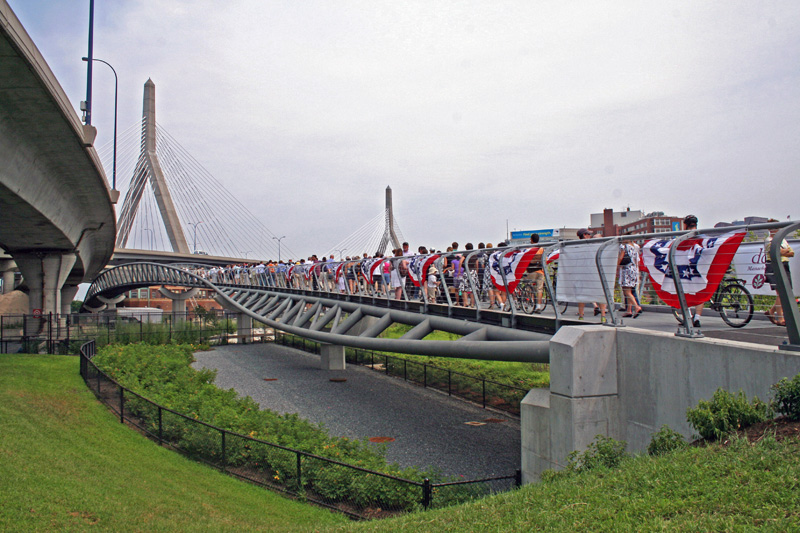
Pedestrians, public officials, and bicyclists thronged the North Bank Bridge on July 13 as the first public crossing from Cambridge to Charlestown, in Boston, took place.
The bridge, which will be used by walkers, runners, bicyclists, rollerbladers, and wheelchair users, connects the Paul Revere Park in Charlestown with the newly opened North Point Park in Cambridge. The bridge and parks are part of a Big Dig mitigation package that also included the construction of the Nashua Street Park, which was completed in 2005.
The new 690-foot, steelwork structure, which travels under the Zakim Bridge, reduces pedestrian travel time from 25 minutes to less than 5 minutes. It is an attractive transportation option for users of the nearby North Point development and the Dr. Paul Dudley White Bicycle Path.
Overseen jointly by the Massachusetts Department of Conservation and Recreation and the Massachusetts Depart-ment of Transportation, the bridge project was started in 2010 using $9.5 million in funds made available through the American Recovery and Reinvestment Act.
Volunteers Needed for MPO Bicycle and Pedestrian Data Collection Program
The Boston Region Metropolitan Planning Organization collects data on the number of people who are biking and walking along the major corridors in the MPO region’s 101 municipalities.
The data are used to estimate the demand for bicycle and pedestrian facilities, and to identify trends and changes in volumes after bicycle and pedestrian projects have been implemented.
This information helps transportation planners and government officials prioritize projects and allocate funding. It also provides a measure with which to evaluate investments in bicycle and pedestrian facilities and their contribution to the region’s transportation network.
In addition, the MPO has used the data to build its Bicyclist/Pedestrian Count Data-base, which is a Web tool that can be found at www.boston mpo.org. This tool continues to evolve as more data are gathered from around the region.
Municipalities and organizations can help to further enhance the database tool by providing information to the MPO on counts they have conducted or plan to conduct. The MPO is also recruiting volunteers to participate in the September counts.
To provide count data or data collection plans, or to volunteer to collect data, contact Christine Bettin, the MPO’s bicycle and pedestrian coordinator, at cbettin@ctps.org or (617) 973-7092 for more information.
Hubway Expands to Cambridge and Somerville and Brookline; Free App Enhances Ease of Use
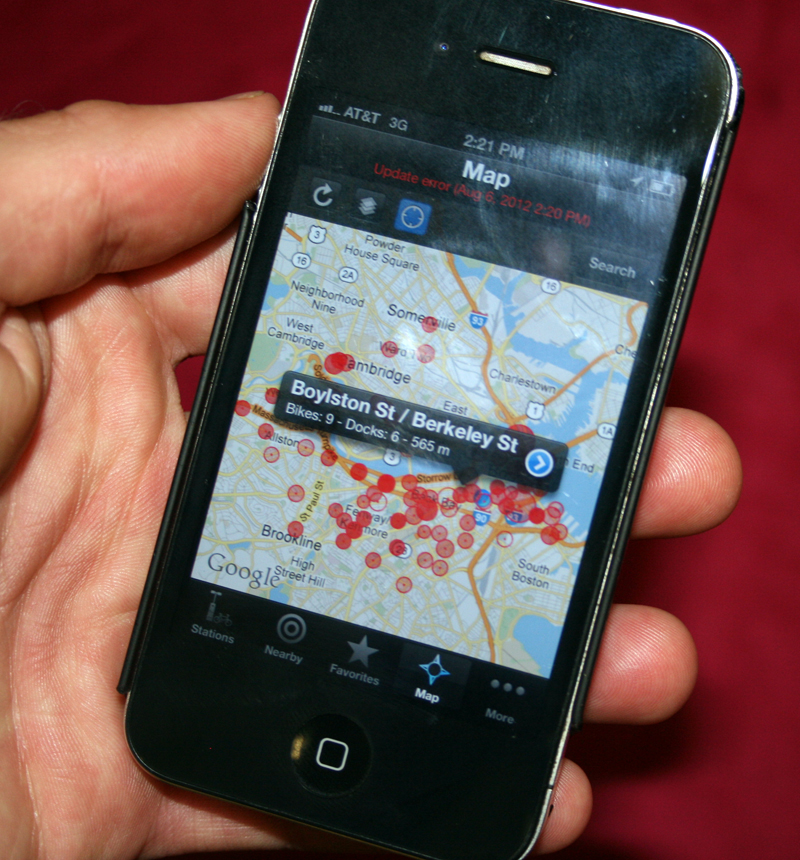
Hubway, the hugely successful bike-sharing program launched in Boston in July 2011, celebrated its first birthday and increased the ease of getting around the region’s urban centers by establishing stations in Brookline, Cambridge, and Somerville in July. Currently there are 60 stations in Boston, 24 in Cambridge, and 11 in Somerville. There are 3 stations in Brookline, with plans to open one more station later this year.
Meanwhile, Spotcycle, a company that provides bike-sharing assistance to users, has developed a free companion app that allows users to locate nearby stations, check for bicycle availability in real time, view bicycle paths, create personalized routes, and even track rental time.
The app may be downloaded to iPhones, BlackBerries, and Android devices by going to www.spotcycle.net.
Next Story • Previous
Story • Back to Top
The Boston Region MPO is monitoring reductions in greenhouse gas (GHG) emissions associated with its Long-Range Transportation Plan, Paths to a Sustainable Region, and its Transportation Improvement Program.
This monitoring is helping the Commonwealth implement its Global Warming Solutions Act (GWSA), which establishes targets for overall reductions in statewide GHG emissions. Estimating carbon dioxide emissions is the Commonwealth’s next step in achieving GHG emission reductions.
MPO staff presented a technical memorandum to the MPO in July. An excerpt from the memo is below; the entire memo may be downloaded from www.bostonmpo.org.
To request a copy in an accessible format, call Anne McGahan at (617) 973-7090 [voice] or (617) 973-7089 [TTY], or e-mail her at amcgahan@ctps.org.
The Value of a Ton of Carbon Monoxide
* Source: United States Environmnetal Protection Agency, “Greenhouse Gas Emissions from a Typical Passenger Vehicle: Fact Sheet,” February 2005.
Except for the third bullet, the information is from: United States Environmental Protection Agency, “Clean Energy Calculations and References,” http://www.epa.gov/cleanenergy/ energy-resources/refs.html (accessed June 2012). The EPA’s values are in metric tons; they have been recalculated as tons for this abstract.
Next Story •
Previous Story • Back to Top
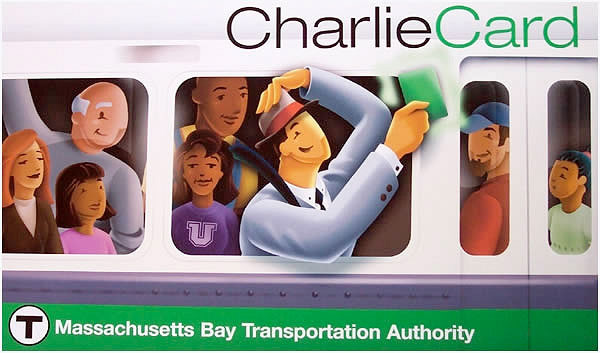
The MBTA has opened a new customer service center at its Downtown Crossing Station that is designed to handle all fare pass transactions including the THE RIDE, Senior, Transpor-tation Access Pass (TAP), and Blind Access CharlieCards.
“The new CharlieCard store means there is no more ‘separate but equal’ for our customers”, said MassDOT Secretary and CEO Richard A. Davey, referring to the two Back Bay service centers, now closed.
The new center is located in the Downtown Crossing Station concourse adjacent to the Arch Street exit. Its hours are Monday through Friday from 8:00 AM to 5:30 PM. For more information, contact the MBTA Customer Communications Department at (617) 222-3200, TTY (617) 222-5146, or www.mbta.com.
Next Story •
Previous Story • Back to Top
The Massachusetts Department of Environ-mental Protection (MassDEP) will hold two hearings on September 13 (see the Calendar for details) to solicit public comments on the proposed elimination of the Red Line–Blue Line Connector Final Design from the State Imple-mentation Plan (SIP) regulations. A SIP is a document that contains procedures detailing how a state will attain compliance with National Ambient Air Quality Standards established by the U.S. Environmental Protection Agency.
More information on the hearings and the proposed amendment is available on MassDEP's website,
http://www.mass.gov/dep/public/ hearings/transit12.htm
Next Story •
Previous Story • Back to Top
MassDOT and the MBTA reached a major milestone for the Green Line Extension project when it received a “Finding of No Significant Impact” (FONSI) from the Federal Transit Admin-istration (FTA) in July. The environmental clearance is the culmination of several years of technical work done by MassDOT and the MBTA in close cooperation with the cities of Cambridge, Somerville, and Medford, and included the participation of hundreds of individuals and local organizations.
Progress Being Made on Application for Federal Funding
The release of the FONSI was preceded by preliminary approval for funding to support approximately one-half of the design for the construction of the Green Line Extension under FTA’s New Starts program.
The New Starts program is one of the most competitive funding programs in the nation. MassDOT and the MBTA are working to clear the next three hurdles in the application process – FTA approval for entry into final design, then approval for construction, and, finally, the execution of a grant agreement.
•
Previous Story • Back to Top
